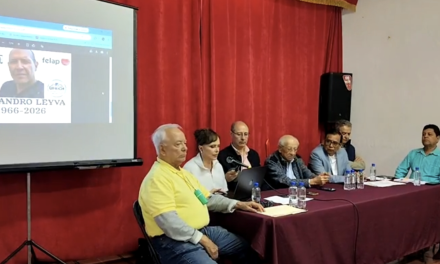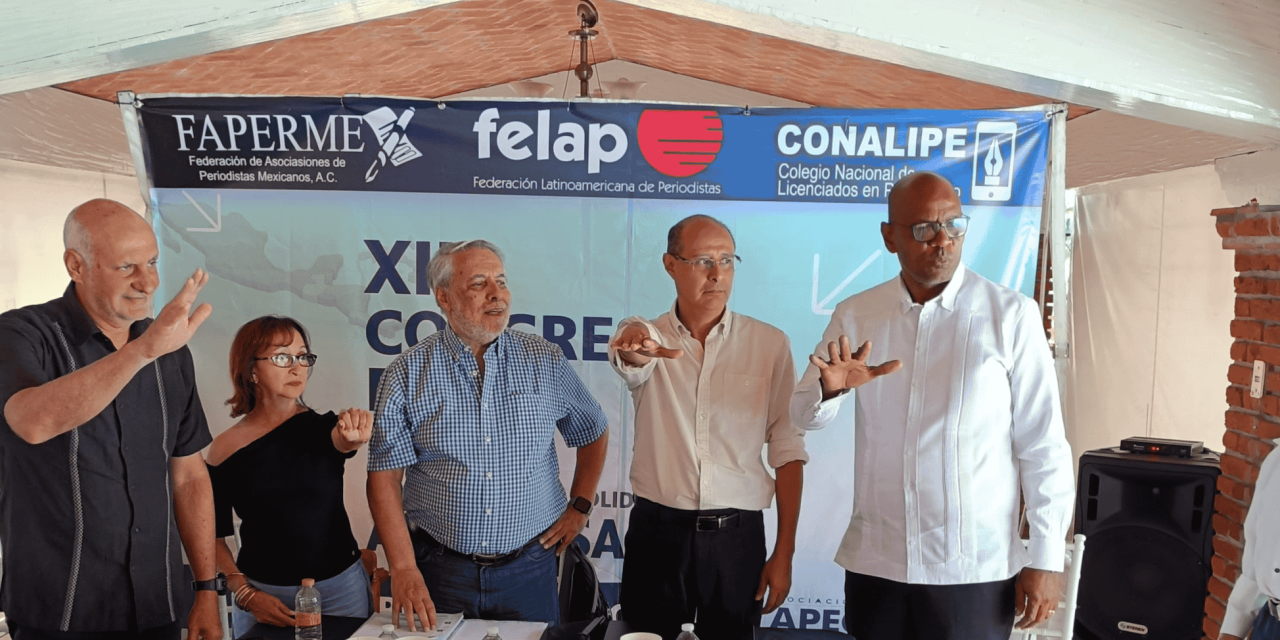
En un encuentro de alta trascendencia histórica y bajo la consigna fundacional de “Periodismo libre en patrias libres”, concluyeron con éxito las actividades del XIII Congreso de la Federación Latinoamericana de Periodistas (FELAP). El magno evento, que coincidió con el 50° aniversario de la organización, cerró sus sesiones con la firma de la Declaración Final de Morelos y la renovación de sus liderazgos para el próximo periodo institucional.
Como resultado de los consensos alcanzados por las delegaciones de toda la región, el Congreso aprobó la conformación de su nuevo Colegio Rector, el cual estará integrado por una dirección horizontal y representativa:
- Raúl Barr (Argentina)
- Teodoro Rentería Villa (México)
- Nydia Bauzá (Puerto Rico)
- Ricardo Ronquillo (Cuba)
- Luis Pérez (República Dominicana)
Asimismo, la asamblea general nombró por unanimidad como presidentes de Honor de la FELAP a Juan Carlos Camaño (Argentina), presidente saliente de la organización, y a Teodoro Rentería Arróyave (México), presidente del Colegio Nacional de Licenciados en Periodismo (CONALIPE), quien concluyó su destacada gestión al frente de la Secretaría de Desarrollo Social de la federación. A estas distinciones honoríficas se sumaron los nombres de los experimentados dirigentes Tubal Páez, José Rafael Vargas e Iván Canelas Alurralde. Se recordó a Ernesto Vera.
Fueron anfitriones las dos agrupaciones mexicanas integrantes de la FELAP, la Federación de Asociaciones de Periodistas Mexicanos, FAPERMEX, representada por su presidente, Luis Javier Hernández Córdova; la secretaria general, Isabela Zozoaga, y el secretario de Finanzas, Gilberto Herrera. Por parte del Colegio Nacional de Licenciados en Periodismo, CONALIPE, su presidente, Teodoro Rentería Arróyave.
La Asociación de Periodistas y Comunicadores del Estado de Morelos, APECOMOR, fue la responsable de la organización del encuentro con la participación de varios de sus integrantes: José Arturo Aguirre Bahena, Pablo Rubén Villalobos Adán, José Montes, Daniel Adame Osorio, Adriana Mújica Murias y Jorge Espíndola.
Un congreso de cara a los desafíos contemporáneos
Las jornadas de trabajo, que iniciaron con el análisis de la realidad mediática regional, contaron con las ponencias de secretarios y líderes gremiales del continente.
Para desarrollar los trabajos del periodo 2026 – 2030 se instalaron tres Comisiones Permanentes de Trabajo enfocadas en soluciones y estrategias clave para el gremio:
- Prensa y Comunicación: Orientada a la democratización de los medios y el combate a la desinformación corporativa.
- Juventud, Nuevas Tecnologías y Capacitación: Destinada al uso crítico de herramientas digitales y el relevo generacional.
- Comisión de Salud y Género: Enfocada en la equidad de oportunidades y los esquemas de protección social de los comunicadores.
Durante los debates, celebrados tanto de manera presencial como virtual, se escuchó el balance de Juan Carlos Camaño, quien advirtió con firmeza que “no hay democracia informativa si no hay democracia económica”. Por su parte, Tubal Páez Hernández denunció el recrudecimiento del asedio económico contra Cuba, reconociendo el respaldo moral e histórico de los pueblos latinoamericanos hacia la isla.
Cincuenta años de memoria y resistencia
El marco del aniversario propició un profundo ejercicio de memoria histórica. El periodista y actual embajador de la República Dominicana en México, Juan Bolívar Díaz, rememoró que la FELAP nació formalmente el 7 de junio de 1976 en la Ciudad de México, como una respuesta solidaria para proteger a los comunicadores perseguidos y víctimas de las dictaduras militares del Cono Sur y la Operación Cóndor.
Díaz rindió tributo a los pioneros de esta trinchera continental, destacando al venezolano Eleazar Díaz Rangel (primer presidente) y al intelectual peruano Genaro Carnero Checa (primer secretario general), quienes junto a figuras posteriores como el mexicano Luis Suárez López defendieron el derecho a la información frente a los monopolios informativos y el terrorismo de Estado.
Con la adopción de la Declaración Final de Morelos y la consolidación de su nueva presidencia colegiada, la FELAP ratifica su vigencia y asume el compromiso de guiar a los trabajadores de la prensa latinoamericana hacia un futuro de mayor soberanía informativa y bienestar social.
Los participantes en el Congreso fueron:
Tubal Páez, presidente de Honor de la FELAP.
Jose Rafael Vargas, presidente de Honor de la FELAP.
Teodoro Rentería Arróyave, presidente de Honor de la FELAP.
Nelson del Castillo, Asociación de Periodistas de Puerto Rico, ASPPRO.
Leandro Torres, secretario general de la Unión de Trabajadores de la Prensa de Buenos Aires, UTBA.
Raúl Barr, presidente de la Obra Social de Trabajadores de Prensa de Buenos Aires.
Teodoro Raúl Rentería Villa, vicepresidente del Colegio Nacional de Licenciados en Periodismo, CONALIPE, de México.
Luis Pérez, Presidente del Colegio Dominicano de Periodistas.
Ricardo Ronquillo, presidente de la Unión de Periodistas de Cuba.
Juan Hererra, vicepresidente del Colegio de Periodistas de Santiago de Chile.
Nydia Bauzá, presidenta de Asociación de Periodistas de Puerto Rico, ASPPRO.
Manuel Vera, vicepresidente de la Asociación de Periodistas de Puerto Rico, ASPPRO
THIAGO CIANGA TANJI, vicepresidente de la Federación Nacional de Periodistas de Brasil.
Santia Bauza, Asociación de Periodistas de Puerto Rico, ASPPRO.
Alex Portugal, integrante de la Asociación de Trabajadores en Periodismo Alternativo y Comunicación Social, ATPC, de La Paz, Bolivia.
Carlos Baldino, secretario de Derechos Humanos de la Unión de Trabajadores de la Prensa de Buenos Aires, UTBA.
Gustavo Vargas, secretario de Prensa de la Unión de Trabajadores de la Prensa de Buenos Aires, UTBA.
Maura Breccia, Colegio de Periodistas de Chile.
Enrique MacMillan, Colegio de Periodistas de Chile.
____________________________________________________________________________________________________
THE XIII CONGRESS OF THE FELAP CONCLUDES ON ITS 50TH ANNIVERSARY: THEY ELECT THEIR NEW KINGNESS AND ENDORSE CONTINENTAL UNITY
In a meeting of high historical significance and under the founding slogan of “Free Journalism in free homelands”, the activities of the XIII Congress of the Latin American Federation of Journalists (FELAP) concluded successfully. The great event, which coincided with the 50th anniversary of the organization, closed its sessions with the signing of the Final Declaration of Morelos and the renewal of its leadership for the next institutional period.
As a result of the consensus reached by the delegations of the entire region, Congress approved the conformation of its new Rector’s College, which will be composed of a horizontal and representative direction:
Raúl Barr (Argentina)
Teodoro Rentería Villa (Mexico)
Nydia Bauzá (Puerto Rico)
Ricardo Ronquillo (Cuba)
Luis Pérez (Dominican Republic)
Likewise, the general assembly unanimously appointed Juan Carlos Camaño (Argentina), outgoing president of the organization, and Teodoro Rentería Arróyave (Mexico), president of the National College of Graduates in Journalism (CONALIPE), as honorary presidents of the FELAP, who concluded his outstanding management at the head of the Secretariat of Social Development of the federation. The names of the experienced leaders Tubal Páez, José Rafael Vargas and Iván Canelas Alurralde were added to these honorary distinctions. Ernesto Vera was remembered.
The hosts were the two Mexican groups members of FELAP, the Federation of Associations of Mexican Journalists, FAPERMEX, represented by its president, Luis Javier Hernández Córdova; the secretary general, Isabela Zozoaga, and the Secretary of Finance, Gilberto Herrera. On behalf of the National College of Graduates in Journalism, CONALIPE, its president, Teodoro Rentería Arróyave.
The Association of Journalists and Communicators of the State of Morelos, APECOMOR, was responsible for organizing the meeting with the participation of several of its members: José Arturo Aguirre Bahena, Pablo Rubén Villalobos Adán, José Montes, Daniel Adame Osorio, Adriana Mújica Murias and Jorge Espíndola.
A congress facing contemporary challenges
The working days, which began with the analysis of the regional media reality, had the presentations of secretaries and union leaders of the continent.
To develop the work of the period 2026 – 2030, three Permanent Working Commissions were installed focused on key solutions and strategies for the union:
Press and Communication: Oriented to the democratization of the media and the fight against corporate disinformation.
Youth, New Technologies and Training: Intended for the critical use of digital tools and generational change.
Health and Gender Commission: Focused on equity of opportunities and social protection schemes for communicators.
During the debates, held both in person and virtually, the balance sheet of Juan Carlos Camaño was heard, who firmly warned that “there is no informative democracy if there is no economic democracy.” For his part, Tubal Páez Hernández denounced the upsurge of the economic siege against Cuba, recognizing the moral and historical support of the Latin American peoples towards the island.
Fifty years of memory and resistance
The frame of the anniversary led to a deep exercise in historical memory. The journalist and current ambassador of the Dominican Republic to Mexico, Juan Bolívar Díaz, recalled that FELAP was formally born on June 7, 1976 in Mexico City, as a solidarity response to protect the persecuted communicators and victims of the military dictatorships of the Southern Cone and Operation Condor.
Díaz paid tribute to the pioneers of this continental trench, highlighting the Venezuelan Eleazar Díaz Rangel (first president) and the Peruvian intellectual Genaro Carneiro Checa (first secretary general), who together with later figures such as the Mexican Luis Suárez López defended the right to information against information monopolies and state terrorism.
With the adoption of the Final Declaration of Morelos and the consolidation of its new collegiate presidency, FELAP ratifies its validity and assumes the commitment to guide the workers of the Latin American press towards a future of greater information sovereignty and social welfare.
The participants in the Congress were:
Tubal Páez, Honorary President of FELAP.
Jose Rafael Vargas, Honorary President of FELAP.
Teodoro Rentería Arróyave, Honorary President of FELAP.
Nelson del Castillo, Association of Journalists of Puerto Rico, ASPPRO.
Leandro Torres, general secretary of the Union of Press Workers of Buenos Aires, UTBA.
Raúl Barr, president of the Social Work of Press Workers of Buenos Aires.
Teodoro Raúl Rentería Villa, vice president of the National College of Graduates in Journalism, CONALIPE, Mexico.
Luis Pérez, President of the Dominican College of Journalists.
Ricardo Ronquillo, president of the Union of Journalists of Cuba.
Juan Hererra, vice president of the College of Journalists of Santiago de Chile.
Nydia Bauzá, president of the Association of Journalists of Puerto Rico, ASPPRO.
Manuel Vera, vice president of the Association of Journalists of Puerto Rico, ASPPRO
THIAGO CIANGA TANJI, vice president of the National Federation of Journalists of Brazil.
Santia Bauza, Association of Journalists of Puerto Rico, ASPPRO.
Alex Portugal, member of the Association of Workers in Alternative Journalism and Social Communication, ATPC, of La Paz, Bolivia.
Carlos Baldino, Secretary of Human Rights of the Union of Press Workers of Buenos Aires, UTBA.
Gustavo Vargas, Press Secretary of the Union of Press Workers of Buenos Aires, UTBA.
Maura Breccia, College of Journalists of Chile.
Enrique MacMillan, College of Journalists of Chile.